


By Leopold Delay, Javelot
The Growing Pressure on Grain Storage Operations
Across Europe and North America, grain storage organizations are operating in an increasingly complex environment. Rising energy costs, labor constraints, stricter quality expectations, and margin pressure are converging at a time when storage networks are expanding through consolidation.
Operational leaders are now tasked with managing larger volumes of grain across more geographically dispersed sites—often with limited increases in staffing or technical infrastructure. At the same time, the cost of spoilage, quality degradation, and inefficiencies in energy usage continues to erode profitability.
Scaling Operations: The Multi-Site Challenge
As consolidation reshapes the grain storage industry, operators are increasingly managing networks of facilities rather than single sites.
This shift introduces new operational complexities:
- Limited visibility across distributed assets
- Variability in local practices and performance
- Increased reliance on less experienced on-site teams
- Difficulty standardizing processes at scale
In this context, one operational lever remains both critical and under-optimized: ventilation.
The Hidden Cost of Manual Ventilation
Ventilation is fundamental to preserving grain quality. Yet, in many facilities, it is still managed using manual processes or basic tools such as thermostats or fixed schedules.
While these approaches may appear sufficient, they introduce several systemic inefficiencies:
1. Increased Risk of Spoilage
Manual or schedule-based ventilation does not account for real-time variations in ambient air conditions or grain mass behavior. As a result, ventilation often occurs when conditions are suboptimal—leading to uneven, inconsistent cooling which poses a risk to the health of the grain.
2. Energy Waste
Operating fans when cooling potential is low is ineffective, and results in significant energy loss. Without precise control, operators cannot ensure that every kilowatt-hour contributes to actual grain cooling.
3. Operational Burden
Manual monitoring becomes increasingly difficult to manage across multiple sites. The results depend heavily on operator judgment, and can be prone to human error. For multi-site operators, standardizing best practices becomes nearly impossible when relying on individual judgment rather than consistent, data-driven logic.
The result is a gap between intended grain preservation outcomes and actual operational performance.
A Shift Toward Data-Driven Ventilation
Automated ventilation powered by data intelligence addresses these challenges by transforming how decisions are made.
Instead of relying on static thresholds or human intervention, modern systems continuously analyze ambient temperature and humidity, in addition to grain temperature profiles within silos. By combining these data streams, automated systems determine when ventilation will actually cool the grain effectively—and only activate when conditions are optimal.
This approach delivers three critical advantages:
Precision
Ventilation is triggered based on the actual thermodynamic potential for cooling—not assumptions.
Efficiency
Automated ventilation can significantly reduce electricity consumption, and lower costs for direct impact on profitability.
Scalability
Operational best practices are embedded into the system, enabling consistent performance across multiple sites without increasing workload.
By centralizing data and decision-making logic, organizations can unlock strategic value :
- Monitor all silos across all sites in real time
- Apply consistent ventilation strategies regardless of location
- Reduce dependency on individual judgment
- Improve overall network performance from a centralized operational model
In essence, automation transforms ventilation from a site-level task into a network-level performance lever.
Evidence from Research: Quantifying the Impact
To validate the effectiveness of automated ventilation, Arvalis—the leading agricultural research institute in France—conducted controlled trials comparing different ventilation strategies.
Methodology
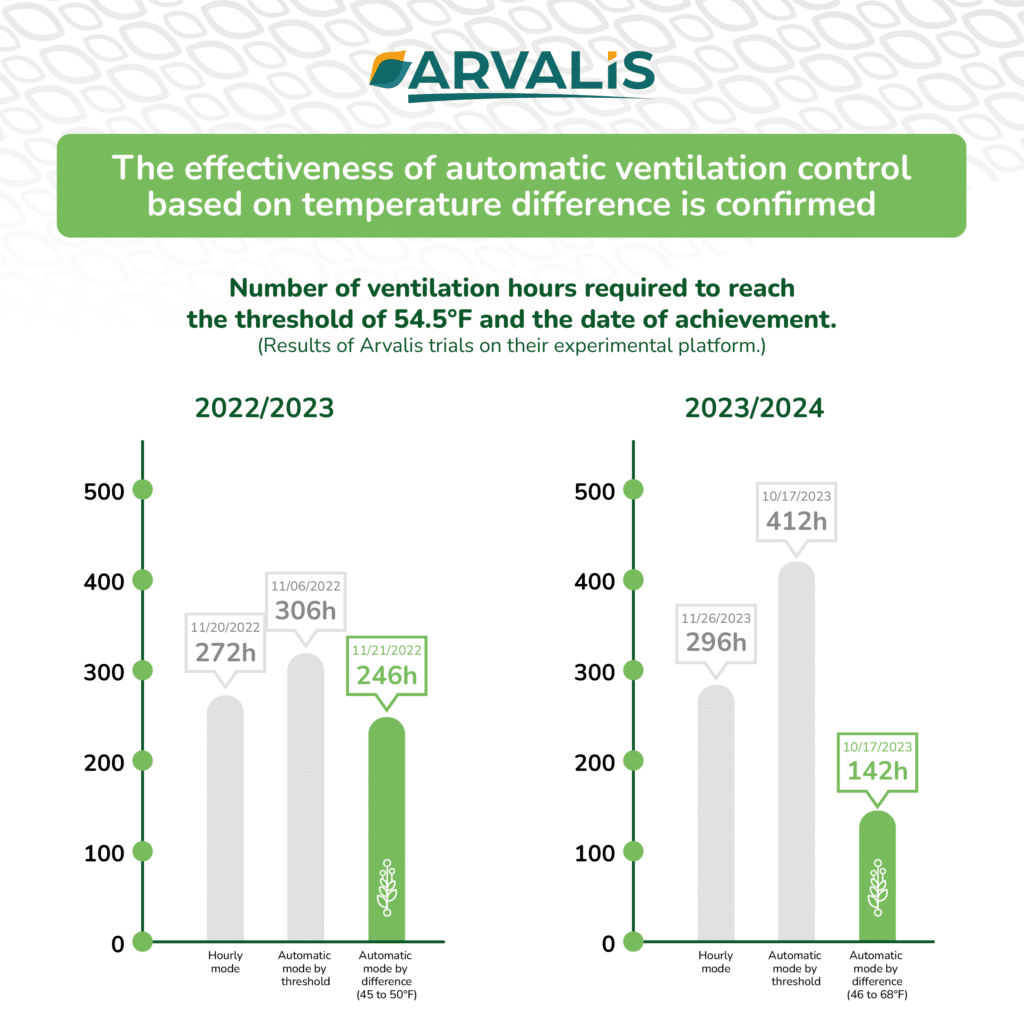
The trials were carried out on Arvalis’ experimental platform over two storage campaigns (2022/2023 and 2023/2024). The objective was to measure the number of ventilation hours required to reach a target grain temperature of 54.5°F, a key benchmark for safe storage. Arvalis evaluated three distinct control approaches:
1. Scheduled Ventilation
Ventilation is activated based on weather forecasts, typically during nighttime windows (10:00 p.m. to 6:00 a.m.), if predicted temperatures remain below a predefined threshold.
2. Thermostat-Based Control
Fans activate automatically when ambient air temperature falls below a fixed threshold, and stop when it rises above it. Cooling is conducted in sequential steps (e.g., first to 68°F, then to 53.5°F ).
3. Temperature-Difference-Based Automatic Control
Ventilation is triggered dynamically based on the difference between grain temperature (at its hottest point) and ambient air temperature.
Instead of a fixed threshold, this method continuously adjusts activation conditions, typically ventilating only when incoming air is 44.5-50°F cooler than the grain (expanded to 46.4-68°F in the second year).
Key Findings
The results across both campaigns were consistent and highly revealing.
1. Fewer Hours, Better Performance
Across all scenarios, the temperature-difference-based automated control consistently required the fewest ventilation hours to reach target temperatures.
In 2023/2024:
- Automated control required only 142 hours
- Thermostat control required the longest with 412 hours
- Scheduled ventilation required 296 hours
Automated control represents a reduction of up to 65% in operating hours compared to thermostat-based control.
Across both years, thermostat-based control required 60% to 90% more ventilation time than temperature-difference control.
A third year of trials during the 2025 harvest campaign, using a lower target temperature of 50°F, confirms this trend. Automated control (Javelot) required 380 hours of ventilation, compared to 692 hours for thermostat-based control, while reaching the target at the same date. Despite the different objective, these results further reinforce the efficiency of temperature-difference-based control.
2. More Ventilation Does Not Mean Faster Cooling
One of the most important insights is that longer fan operation does not equate to faster or better cooling.
While thermostat-based control sometimes achieved slightly earlier completion dates, the difference was minimal—typically no more than seven days.In addition, thermostat-based control required dramatically more energy and operating time for cooling.
3. Air Quality Matters More Than Activation Frequency
The study highlights a critical distinction:
- Thermostat-based systems activate more frequently, including when air is only marginally cooler
- Temperature-difference based automatic control activates less often, but with significantly colder air
As shown in the analysis of incoming air temperatures, the differential approach consistently injects cooler air into the grain mass, which is more effective for heat extraction.
Beyond Efficiency: Business Impact
Reducing ventilation hours is not just a technical improvement—it has direct business implications.
Energy Cost Reduction
By eliminating ineffective fan usage, operators can significantly reduce electricity consumption—often by up to 30%.
Improved Grain Quality
More precise cooling reduces the risk of hotspots, moisture migration, and spoilage, preserving grain value.
Increased Asset Performance
Storage facilities operate more predictably, with fewer interventions and less variability.
Enhanced Sustainability
Lower energy consumption translates into reduced carbon footprint—an important factor for both regulators and customers.
Javelot: Turning Data into Operational Advantage
While the concept of automated ventilation is gaining traction, its effectiveness depends on the quality of data and the intelligence applied to it.
Javelot stands out by combining the following features:
- Monitoring of grain and ambient conditions to prevent drying and hotspots with instant alerts
- Advanced algorithms that determine optimal ventilation windows and automated aeration
- A centralized platform to view and manage multiple sites in real time
- Continuous performance analysis to improve ventilation efficiency over time
Once connected, storage operators gain full visibility across their network—enabling better decisions, faster response times, and consistent outcomes.
More importantly, Javelot shifts ventilation from a reactive task to a proactive, data-driven strategy—one that aligns operational efficiency with business performance.


