



The effectiveness of Javelot automatic control confirmed by Arvalis
At its Boigneville (91) pilot site, ARVALIS compared three ventilation control methods, including Javelot's automatic control mode.
What impact does ventilation control have on ventilation performance?
At its pilot site in Boigneville (91), ARVALIS has been comparing different grain storage strategies for several years, using batches of soft wheat harvested from the farm at ARVALIS' experimental station. The aim is to understand the impact of these different strategies on grain quality, infestation levels and cooling performance.
What methodology did we apply?
Among the comparison criteria is the ventilation control method. Three control modes are evaluated:
Time-based control
A so-called "time-based" control method, which consists of activating ventilation only if the forecast temperatures remain below a set threshold throughout the entire period from 10:00 p.m. to 6:00 a.m. The decision is made daily at 5:00 p.m., based on hourly forecasts from the "MétéoCiel" website (AROME model, hourly forecasts). Each ventilation cycle lasts 8 hours.
Automatic threshold-based control (thermostat)
Automatic control using a thermostat (Sec-LIS©), which involves setting a temperature threshold to automatically activate ventilation. Ventilation cycles begin as soon as the outside temperature falls below the set threshold and stop as soon as it rises above it. Their duration varies.
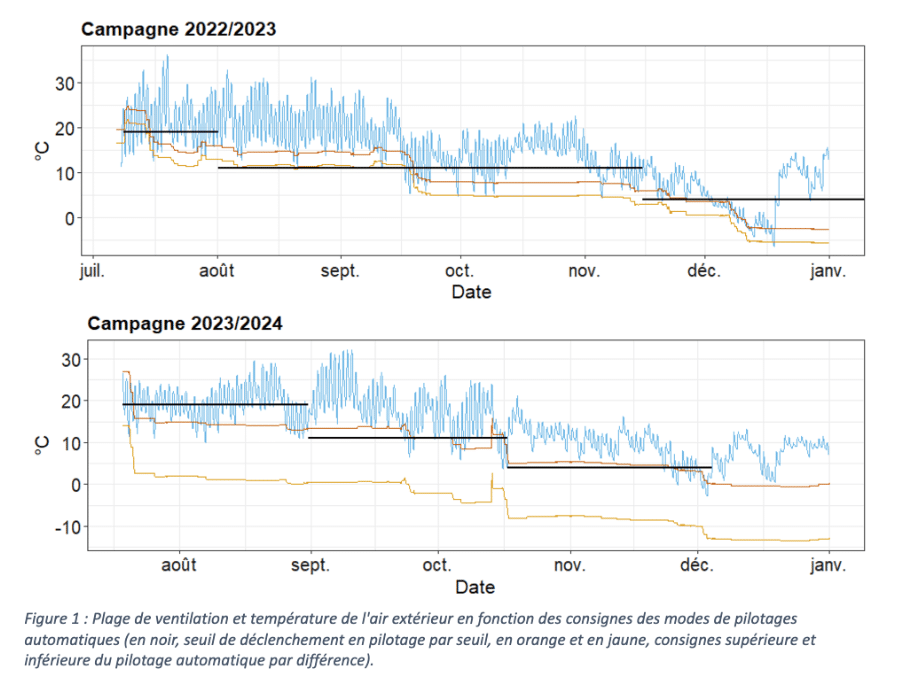
These first two control methods are implemented in successive stages. The first stage aims to bring the grain temperature down to 20°C, while the second aims to reach 12°C. The warming of the grain during ventilation is taken into account when setting the activation thresholds. In this case, it was measured at 1°C. The activation thresholds are therefore set at 19°C and 11°C.
Automatic temperature differential controlJavelot
An automatic control method that takes into account both the outside air temperature and the grain temperature, based on the temperature difference between the warmest point of the stored grain and the outside temperature (the so-called "automatic" mode of the Javelot system).
This third control method is not operated in stages but continuously. The fan activation setpoint is constantly adjusted according to the outside temperature and the grain temperature. The default settings were used during the first year of testing, with ventilation activated when the air temperature was 7°C to 10°C lower than the temperature at the warmest point of the grain. In the second year, the settings were modified to expand ventilation opportunities, allowing the use of air with a temperature between 8°C and 20°C below that of the warmest point of the grain. Each ventilation cycle lasts a minimum of 1 hour in the first year and 3 hours in the second year.
The three storage bins, each operated using a different ventilation strategy, are all filled with 40 to 45 tonnes of soft wheat and ventilated using identical fans. To monitor temperatures, the bins are equipped with temperature monitoring cables that measure grain temperature throughout the entire height, with sensors spaced 80 cm apart. To compare the three control methods, cooling of a storage bin is considered complete when all temperature readings taken at the same time are at or below 12°C, the temperature below which insects can no longer reproduce. To assess how sensitive the performance of the different control methods is to this target, the number of hours required for all measurement points to fall below 12.5°C was also calculated.
What is the impact on the performance of aeration stategies?
Two indicators can be used to assess ventilation performance: the number of hours required to reach the target temperature and the date on which cooling is completed.
Tables 1 and 2 show the number of ventilation hours required to reach 12°C or 12.5°C using each of the three control methods considered. At first glance, there is a significant effect linked to the crop year, regardless of the control method, both in terms of the number of ventilation hours required and the date on which cooling is completed. Another observation is that aiming to cool all the grain to 12°C rather than 12.5°C, including at the top of the grain pile, can result in a considerable number of additional ventilation hours. This is particularly true for control method 2 during the 2022/2023 season.
However, regardless of the crop year or target temperature, automatic temperature differential control (mode 3) consistently requires the fewest ventilation hours, while automatic threshold-based control (mode 2) requires the most. The difference between the two control methods is significant: mode 2 requires 60% to 90% more ventilation hours. Conversely, threshold-based control achieves the earliest completion of grain cooling in all observed situations. However, when there is a difference, it is no more than 7 days.


How can the differences between the three ventilation control methods be explained?
With only two years of trials, we can only report observations that will need to be confirmed through further testing over a longer period.
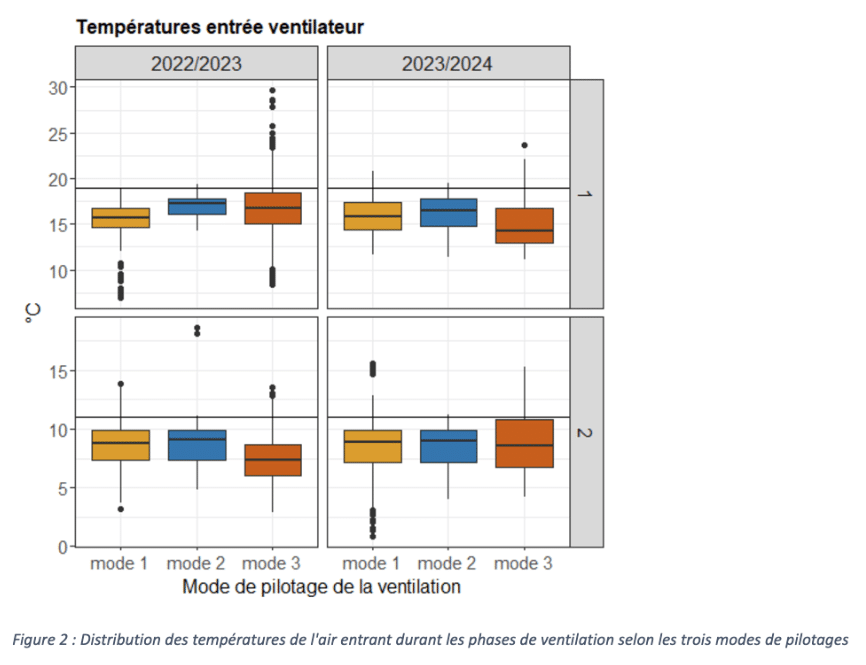
When comparing modes 1 and 2, both operated in two stages with identical temperature thresholds, we observe that the decision rule applied to mode 1 (requiring forecast temperatures to remain below the threshold for the entire period from 10:00 p.m. to 6:00 a.m.) results in ventilation being carried out later. This is particularly evident in 2023/2024, when the cooling completion date was delayed by more than a month compared with automatic threshold-based control. As a result, the average temperature of the air blown into the grain is consistently lower with this time-based control method, despite a small number of ventilation hours during which the air temperature exceeds the threshold, generally at the beginning of a ventilation cycle, due to inaccuracies in the weather forecasts.
Regarding the two automatic ventilation control methods, an analysis of how the settings affect the temperature of the incoming air reveals a significant difference between them, particularly at the beginning of storage when the grain is still warm. This is illustrated in Figure 1. The possible ventilation periods are those during which the outside air temperature is below the fixed activation threshold for mode 1 (shown in black), or those during which it falls between the two variable thresholds for activation (shown in orange) and shutdown (shown in yellow) for mode 3. At the beginning of storage, during the first cooling stage of mode 2, the possible ventilation periods for this mode are much more frequent than for mode 3. As a result, the fan is activated frequently, but often at higher outside air temperatures, as shown in Figure 2.
Based on these two years of observations, the emerging conclusion is that the most efficient way to cool grain is to activate ventilation when the air temperature is 7°C lower than the temperature at the warmest point of the grain (while taking into account the warming of the air caused by the fan). By doing so, the air blown into the grain is, on average, cooler than when ventilation is controlled using a single temperature threshold for each cooling stage. However, this approach may result in a slight delay in cooling completion.
Note: Lowering the lower ventilation shutdown threshold for mode 3 between the 2022/2023 and 2023/2024 seasons made it possible to take advantage of additional ventilation hours favourable to cooling at lower temperatures. No impact on potential grain rehumidification was observed during the two years of monitoring.

Article written by Katell Crépon, Head of Grain Storage and Preservation at Arvalis (Boigneville)